CrossFit Lingo for Beginners: 40 Essential WOD Terms, Workout Formats, and Exercises Explained
CrossFit lingo for beginners can feel confusing at first, but once you understand the basic terms, workout formats, and common exercises, the whole training world starts to make sense.
If you are new to CrossFit, functional fitness, or open gym training, the language can feel like another workout by itself. WOD, AMRAP, EMOM, RX, scaling, clean, snatch, double unders, wall balls, rowing, time cap. Everyone says it like it is obvious.
It is not obvious in the beginning. I know because I have been around this training world for more than 20 years, and I have seen the same look on people’s faces when they first walk into a box or open a workout app and see a wall of terms they do not understand.
May 2026
CROSSFIT LINGO FOR BEGINNERS: WHY THIS GUIDE EXISTS
CrossFit has its own language. Some of it comes from weightlifting. Some from gymnastics. Some from conditioning. Some from the old-school culture of the box.
And if nobody explains it, you end up guessing.
That is exactly what CoachSLY was built to fight: guessing. Not just guessing what workout to do, but guessing what the workout even means.
So this is the simple guide I wish every beginner had. No ego. No gatekeeping. Just the main CrossFit terms, workout formats, and exercises explained in plain English.
FIRST: WHAT IS A WOD?
WOD = Workout of the Day
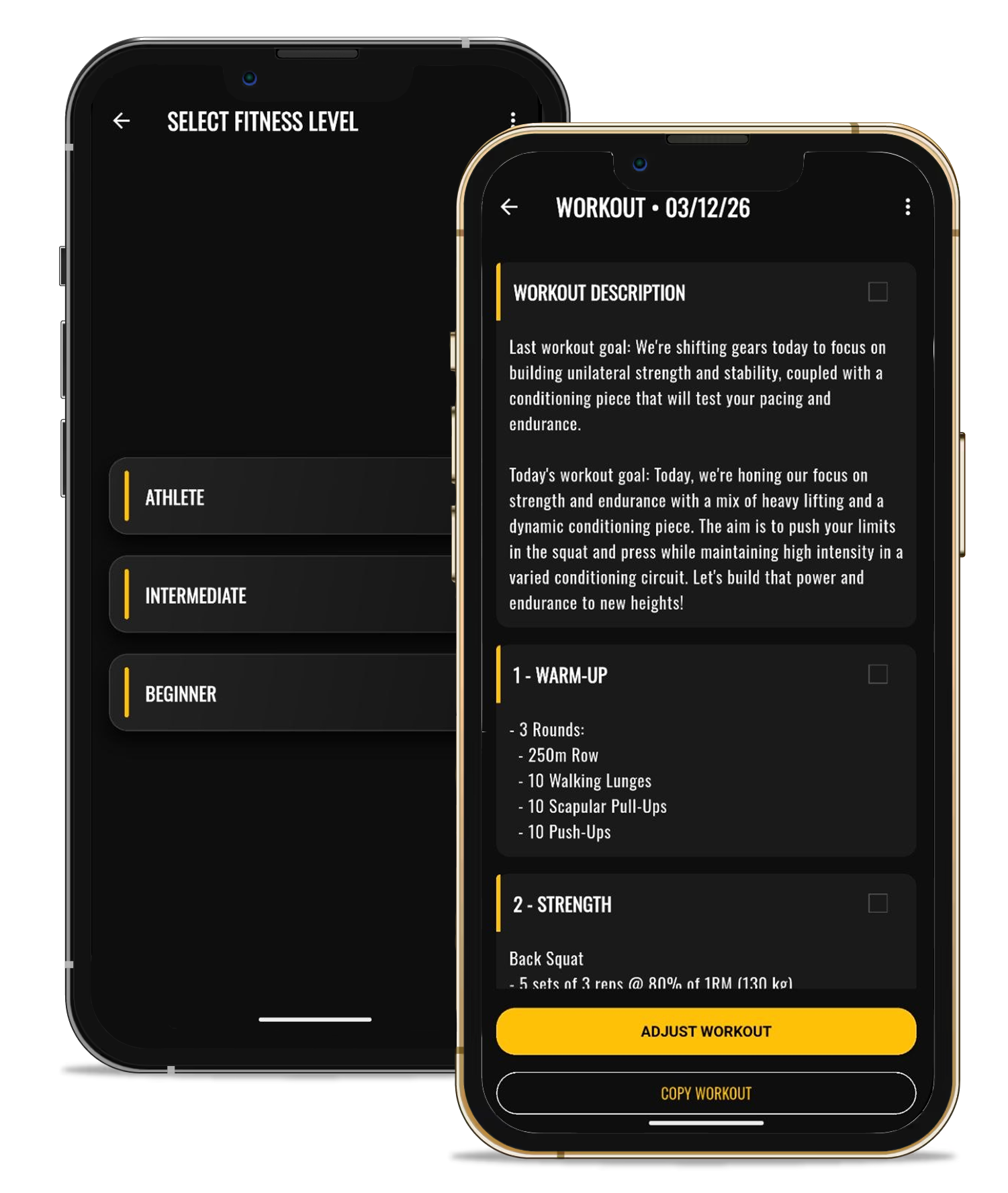
This is probably the most common CrossFit term. A WOD is the workout programmed for that day. It usually includes a warm-up, strength or skill work, conditioning, and sometimes accessories or cooldown work.
In simple words: the WOD is the plan.
A good WOD is not just random suffering. It should have a purpose. Maybe the goal is strength. Maybe conditioning. Maybe skill practice. Maybe a mix of all three.
That is why CoachSLY builds workouts with structure: warm-up, strength or skill, conditioning, accessories, cooldown, and notes. Every piece has a job.
THE MAIN CROSSFIT WORKOUT FORMATS
These are the formats you will see all the time in CrossFit, functional fitness, and CoachSLY-style workouts.
AMRAP
As Many Rounds or Reps As Possible. You work for a set time and try to complete as much quality work as possible.
EMOM
Every Minute On the Minute. At the start of each minute, you perform the assigned work, then rest for whatever time is left.
FOR TIME
Complete the work as fast as possible while keeping good form. Your score is your finish time.
RFT
Rounds For Time. You complete a set number of rounds as fast as possible. Example: 5 rounds for time.
CHIPPER
A longer workout with a big list of movements. You “chip away” at the reps until the workout is done.
INTERVALS
Work and rest are planned. Example: 4 rounds of 3 minutes hard, 1 minute rest.
TABATA
Usually 20 seconds of work and 10 seconds of rest, repeated for multiple rounds. Short, sharp, and uncomfortable.
LADDER
Reps go up or down each round. Example: 2-4-6-8-10 or 10-8-6-4-2.
WHAT AMRAP REALLY MEANS
AMRAP stands for As Many Rounds or Reps As Possible.
Example:
12-minute AMRAP:
10 wall balls
10 box jumps
10 kettlebell swings
You repeat that sequence for 12 minutes and record how many rounds and reps you completed.
The point is not to sprint like an idiot for one minute and die. The point is to find a pace you can hold, keep moving, and stay consistent.
WHAT EMOM REALLY MEANS
EMOM stands for Every Minute On the Minute.
Example:
10-minute EMOM:
Minute 1: 12 calories row
Minute 2: 10 push-ups
When the minute starts, you do the work. If it takes 40 seconds, you rest 20 seconds. Then the next minute starts.
EMOMs are great for pacing, skill practice, strength work, and conditioning without turning every workout into chaos.
WHAT “FOR TIME” MEANS
A For Time workout means you complete the assigned work as fast as possible, with good standards and safe movement.
Example:
3 rounds for time:
400m run
21 kettlebell swings
12 pull-ups
Your score is your time.
The trap is thinking faster always means better. It does not. Bad reps are not fitness. Move well, then move fast.
WHAT RX MEANS
RX = As Prescribed
RX means doing the workout exactly as written: the same movements, weights, reps, and standards.
People get too emotional about RX. They think scaling means weakness.
It does not.
Scaling means you are training the right version of the workout for your current level. That is smart training.
WHAT SCALING MEANS
Scaling means modifying the workout so you can hit the intended stimulus safely and effectively.
You can scale:
- Weight
- Reps
- Rounds
- Movement difficulty
- Workout duration
- Equipment
Example: if the workout says pull-ups and you do not have pull-ups yet, you might do ring rows or banded pull-ups.
If the workout says double unders and you cannot do them yet, you might do single unders.
Scaling is not cheating. Scaling is how you keep the workout useful.
COMMON CROSSFIT TERMS YOU NEED TO KNOW
REP
One repetition of a movement. One squat equals one rep.
SET
A group of reps. Example: 3 sets of 10 push-ups.
ROUND
One full pass through the workout movements.
TIME CAP
The maximum time allowed to finish a workout.
PR
Personal Record. Your best known lift, score, time, or result.
1RM
One Rep Max. The heaviest weight you can lift for one good rep.
LOAD
The weight used in the workout or strength section.
STIMULUS
The intended feeling or training goal of the workout.
WHAT STIMULUS MEANS
This word matters.
Stimulus means what the workout is supposed to train.
Is it supposed to be fast and light? Heavy and controlled? Long and steady? Short and painful? Skill focused? Grip heavy? Leg burning? Aerobic?
When people ignore stimulus, they ruin good workouts.
Example: if a workout is meant to be fast and you choose a weight that forces you to stop every 3 reps, you missed the point. If a workout is meant to be heavy and controlled, but you go too light and race it, you also missed the point.
This is why CoachSLY gives structure and notes, not just movements.
THE THREE BIG CROSSFIT MOVEMENT CATEGORIES
Most CrossFit workouts mix three main types of work:
1. WEIGHTLIFTING
This includes barbell, dumbbell, kettlebell, wall ball, sled, and loaded movements.
Examples: cleans, snatches, deadlifts, squats, presses, thrusters, kettlebell swings.
2. GYMNASTICS
This means bodyweight control.
Examples: pull-ups, push-ups, handstand push-ups, toes-to-bar, muscle-ups, ring rows, burpees.
3. MONOSTRUCTURAL CARDIO
This means repetitive conditioning work.
Examples: running, rowing, biking, skiing, jump rope.
A good training week balances these areas instead of smashing the same thing every day.
COMMON CROSSFIT EXERCISES EXPLAINED
Now let’s break down the movements people talk about all the time.
AIR SQUAT
A basic bodyweight squat. Hips go back and down, chest stays up, feet stay planted. This is one of the foundations of CrossFit.
BACK SQUAT
A squat with the barbell on your upper back. Great for building leg strength, trunk strength, and overall power.
FRONT SQUAT
A squat with the barbell on the front of your shoulders. It forces a more upright position and builds serious leg and core strength.
OVERHEAD SQUAT
A squat while holding the barbell overhead. This requires mobility, balance, control, and strength. It is more advanced than a regular squat.
DEADLIFT
Picking a loaded barbell from the floor to a standing position. Simple idea, serious movement. It trains the posterior chain: legs, glutes, back, grip, and trunk.
CLEAN
A weightlifting movement where you move the barbell from the floor to the front rack position on your shoulders.
A power clean means you catch it above parallel. A squat clean means you catch it in a full squat.
JERK
A movement where you drive the barbell from your shoulders to overhead using your legs and arms together. You may see push jerk or split jerk.
CLEAN AND JERK
One of the Olympic lifts. First you clean the bar to your shoulders, then jerk it overhead.
SNATCH
The other Olympic lift. You move the barbell from the floor to overhead in one motion. It is technical, fast, and powerful.
A power snatch is caught higher. A squat snatch is caught in a full overhead squat.
THRUSTER
A front squat straight into an overhead press. It is simple to understand and horrible in the best possible way.
WALL BALL
A squat with a medicine ball followed by a throw to a target on the wall. Legs, lungs, shoulders, coordination. Wall balls show up everywhere.
KETTLEBELL SWING
A hip-driven movement where you swing a kettlebell using power from your hips, glutes, and hamstrings. It is not supposed to be a shoulder raise.
BOX JUMP
Jumping onto a box and standing tall at the top. It trains power, coordination, and confidence. Step-downs are often the smarter choice when fatigue builds.
BURPEE
You get down to the floor, get back up, and usually jump. Nobody loves burpees while doing them. Everybody respects what they do.
PULL-UP
Pulling your chin over the bar. In CrossFit you may see strict pull-ups, kipping pull-ups, or chest-to-bar pull-ups.
RING ROW
A scalable pulling movement using gymnastic rings. Great for beginners, warm-ups, and building pulling strength.
TOES-TO-BAR
Hanging from a pull-up bar and bringing your toes to the bar. It trains grip, core, lats, timing, and control.
HANDSTAND PUSH-UP
A vertical pressing movement performed upside down. It can be strict or kipping. This is advanced and should be scaled when needed.
MUSCLE-UP
A high skill gymnastics movement where you pull yourself above the rings or bar and finish in a dip support position. It combines pulling, transition, pressing, timing, and strength.
DOUBLE UNDERS
Jump rope where the rope passes under your feet twice in one jump. It takes rhythm, timing, relaxed shoulders, and patience.
If you are new, single unders are the normal scale. No shame. Build the skill.
ROW
Usually done on a rowing machine. You may see calories, meters, or time. Rowing trains legs, lungs, back, and pacing.
BIKE
Usually an air bike or bike erg. It can be used for calories, distance, or intervals. The air bike is famous for making strong people humble.
SKI ERG
A machine that mimics a ski-pulling motion. It hits lats, core, triceps, and lungs.
RUN
Simple, effective, and usually disliked until it is over. Running in CrossFit may show up as short sprints, 400m repeats, or longer conditioning pieces.
COMMON ABBREVIATIONS YOU WILL SEE
DB
Dumbbell.
KB
Kettlebell.
BB
Barbell.
DU
Double unders.
SU
Single unders.
HSPU
Handstand push-up.
T2B
Toes-to-bar.
C2B
Chest-to-bar pull-up.
MU
Muscle-up.
GHD
Glute-ham developer. Often used for sit-ups or posterior chain work.
WHY CROSSFIT WORKOUTS FEEL CONFUSING AT FIRST
CrossFit combines a lot of training worlds into one system.
One day you might squat heavy. The next day you might row, do pull-ups, and swing a kettlebell. Another day you might work on Olympic weightlifting technique, then finish with intervals.
That mix is what makes it powerful. But it also makes it confusing for beginners.
The solution is not to memorize everything in one day. The solution is to understand the patterns:
- What is the workout format?
- What is the intended stimulus?
- What movements are involved?
- What should be scaled?
- What score should be recorded?
Once you understand those questions, the language starts making sense.
HOW COACHSLY USES THIS LANGUAGE
CoachSLY uses CrossFit-style terminology because that is the training world it comes from.
But the goal is not to confuse you.
The goal is to give you real training language with enough structure that you understand what to do.
In CoachSLY, a workout may include:
- A strength or skill section
- A conditioning piece like AMRAP, EMOM, For Time, intervals, or chipper
- Accessories to support strength and balance
- A cooldown with clear drills
- Coach notes to explain the goal and scaling
That means you are not just getting random movements. You are getting a structured session built around a purpose. You can also read more about the idea behind the app on the About CoachSLY page.
BEGINNER EXAMPLE: HOW TO READ A WORKOUT
Let’s say you see this:
12-MINUTE AMRAP
10 wall balls
10 box jumps
10 kettlebell swings
Here is what it means:
- You work for 12 minutes.
- You repeat the three movements in order.
- Your score is total rounds and reps.
- You should choose versions of the movements you can keep moving through.
- The goal is steady conditioning, not one chaotic sprint.
That is the difference between reading words and understanding the workout.
USEFUL CROSSFIT AND WEIGHTLIFTING RESOURCES
For official CrossFit methodology, movement standards, and workout education, you can also check the official CrossFit website.
For Olympic weightlifting basics and competition-level movement references, the International Weightlifting Federation is also a useful source.
For structured CrossFit-style workouts built around your level, equipment, time, personal records, and feedback, visit the CoachSLY homepage.
FINAL WORD
If you are new to CrossFit or functional fitness, do not let CrossFit lingo for beginners scare you away.
Everyone was new once.
You do not need to know every term on day one. You just need to understand enough to start, scale properly, and keep learning.
WOD. AMRAP. EMOM. RX. Scaling. Clean. Snatch. Double unders. Row. Wall balls.
At first it sounds like a different language.
Then one day it becomes simple.
You look at the workout, understand the goal, scale what needs to be scaled, and get to work.
That is the point.
No guessing. No ego. Just training.
Just Keep Moving.
READY TO TRAIN WITHOUT GUESSING?
CoachSLY gives you structured CrossFit-style workouts built around your level, equipment, time, personal records, feedback, and real life.
Stop scrolling for random WODs. Get the plan. Adjust when needed. Train with purpose.